At a recent Ontario Artist
Blacksmith Association event I was asked to
put some more information about the air hammer
I have for sale on my web site. The following
gives a general overview but I also welcome
specific questions as well.
This air hammer has become an essential tool
in my shop. I use it almost everyday for
everything from hot punching to drawing out to
texturing raw steel.
In my opinion any shop that is trying to make
a living from blacksmithing needs an air
hammer. It certainly increases the stock size
that you can work with but it also has the
control to work the smaller sizes without
destroying them.
I regularly will draw out 1/4 round bar on my
hammer. Your first response is probably
"Lazy!" Well yes and no. If in a day I have
100 pieces of 1/4 round to point I can do this
in half the time with no fatigue!
Suddenly I can work longer, produce more and
maintain the same control. Who wouldn't use
it? What is the old saying?
Work Smarter not
Harder!
I invite you to carefully examine
the information below and check other
competitors. We all offer different features.
Please keep in mind that my price compares to
a near wholesale price of the hammer of other
producers.
Price is not everything but you are welcome to
arrange a visit to my shop and try it out to
see the possibilities of this fundamental
tool.
Build Your Own Air Hammer
With the plans I use.
These plans I have updated to
build 75 lb or 120 lb Blacksmith Air Hammers
Pictured Below. These plans can save you
several $1000's of dollars if you like do it
your self projects.
If you would like more information about this
set of plans,
which you can download in pdf format. Click
Here
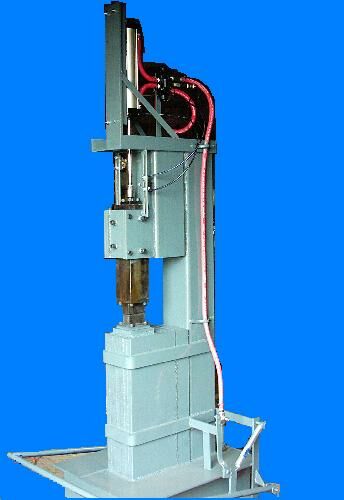
This is a side view of the
air hammer, and
gives you an overview of the
machine.
This is a Kinyon style of hammer.
This air hammer requires a separate
compressor that can provide 10 cfm
at 90 or 100 psi. I have run it on a
smaller compressor but any serious
work will have the compressor
running beyond its duty cycle.
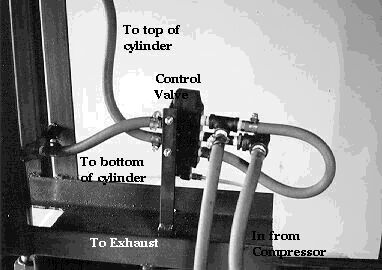
The basic principle of the Kinyon
air hammer is that there is a
constant air source supplied. By
depressing the foot valve air
pressure is exhausted and creates an
imbalance in the air pressure on the
two sides of the piston.
The more the foot valve is opened
the greater the imbalance and the
farther and faster the air cylinder
moves. Once the air cylinder has
moved a specified distance it trips
a pilot switch which in turn causes
the control valve to shift. Once the
control valve shifts position it
tells the air cylinder to change its
direction of travel.
Eventually the cylinder
again trips the pilot switch
starting the whole process over
again. Attached to the air cylinder
is the hammer head weight (75 lb
block of steel). The rest of the
machine is basically framework to
hold everything together.
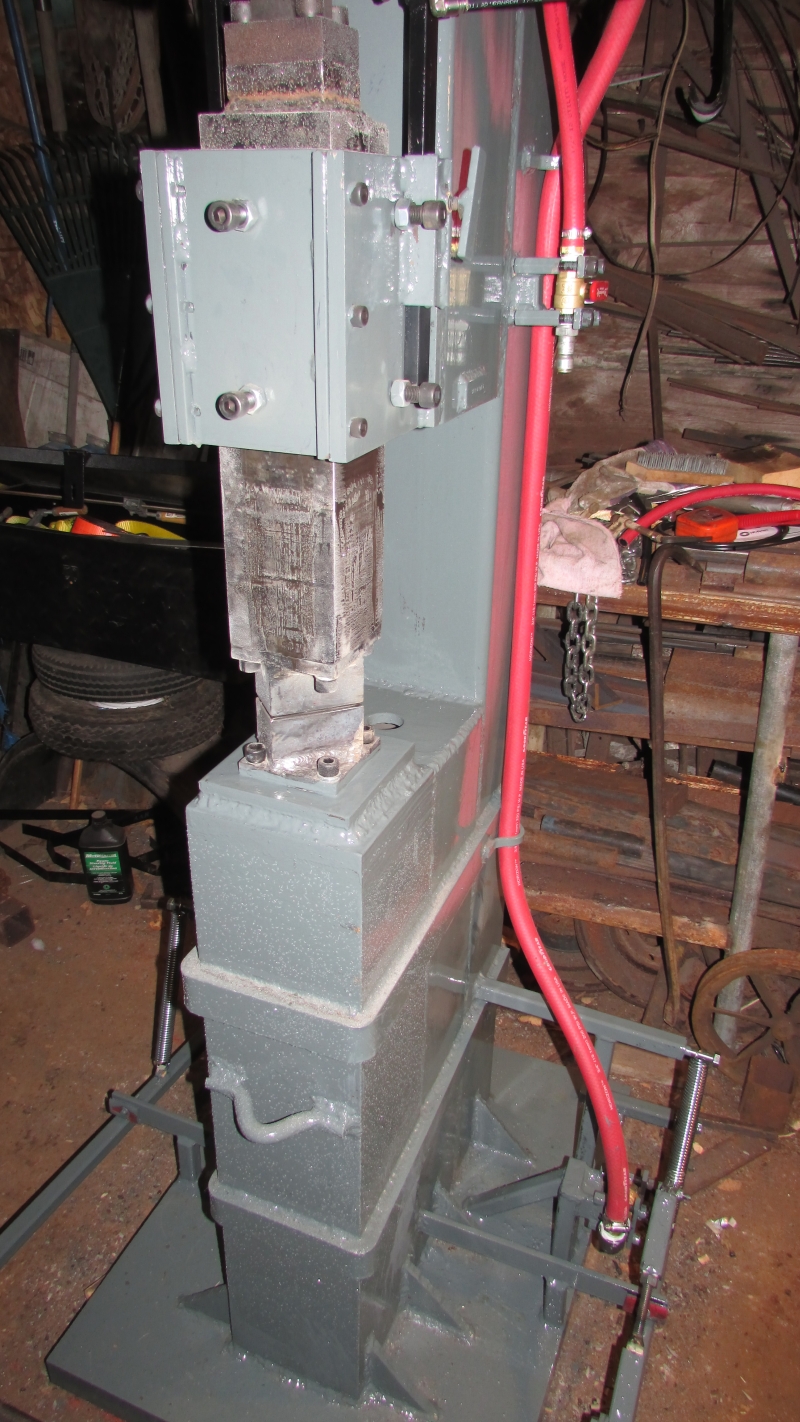
I have chosen to use air cylinders
with 1" piston rod instead of the
usual 3/4 in for the extra
durability. The dies are S7 and are
2 inches high and 2 inches wide by 3
1/2 inches long. The top die bolts
into the head weight, where as the
bottom die bolts on the anvil post.
The actual plumbing is a
little different from what Ron
Kinyon designed. I have found this
works well allowing an easily
adjustable striking force.
The total weight of the machine is
about 1200 lbs. This machine
is suitable in a shop that wants to
take the next step above hand
smithing with a minimal cost.
This is not a Kuhn hammer and
shouldn't
be expected to perform as one.
The following video shows
a few of the techniques that I use on this
air hammer. There are many more ways to
use this tool but the video will get you
thinking of some possibilities. the video
is about 9.5 minutes long and is 75 Mb in
size so it will take awhile to download.
If you are on dial up it may take a couple
of hours.
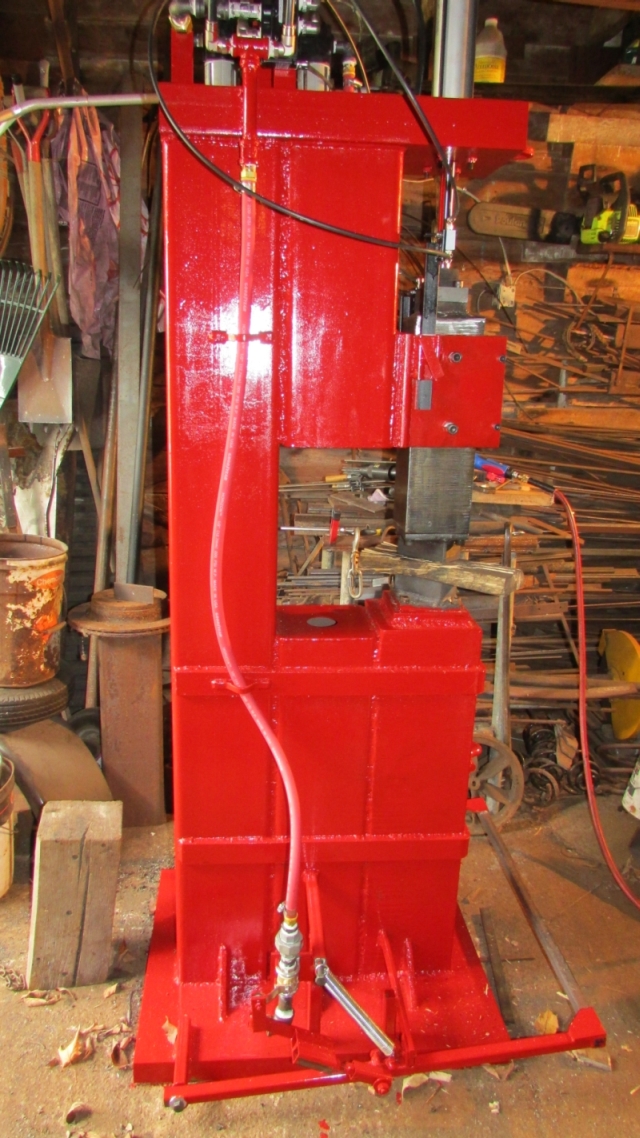
This is a light
hammer but can do a remarkable amount of
work especially with the addition of
specialty dies and tools.
The one I have in my shop was a 75 lb early
model and it is my right hand. I use it for
all the heavy draw outs as well as for
pointing small hooks made from 1/4 inch rod.
The 75 lb will work 1 1/2 square stock
fairly comfortably. I have worked 2 inch
square (almost twice the recommended
material) although it moved it it was slow
going.
In my shop I am typically using 1 inch
square and down. I do keep tinkering with
the design and may change slightly from the
photographs as I make improvements. I welcome
people to make an appointment to come to
my shop and test the hammer out. It is
very easy to get the hang of and often
working with it answers many questions.
I make these hammers as they are ordered
so there is some possibility of slight
custom design changes.
My January 2008 newsletter is devoted to
use of this air hammer. If you wish to
read more information about the air hammer
just click onJanuary 2008.
If you wish to read my
other articles and newsletters please join
my free membership by filling out the form
at the top right. Please call
519-366-2334 and ask for David or email me.
Specifications:
Head
Weight
75 lbs
Overall Weight 1200 lbs
Height 7 ft
Foot Print 24 in x 30 in
Recommended Air Source 10 cfm at 90 psi
Strokes Per minute (max) 180
Max recommended bar size 1.5 in x 1.5 in
Recommended Air Pressure 90 to 120 Psi
Die size 2" high x 2" wide x 3.5" long
Die Material S7 (comes with flat dies)
(All specifications are approximate and
depend some what on availability.)
Price better part of $10,000.00 Canadian,
at my shop plus appropriate taxes. ( price
depends on availability and current
component prices. I will supply you with a
current quote.)
New 120 lb Air Hammer
I have started building a bigger
air hammers of 120 lbs. Specifications:
Head
Weight
120 lbs
Overall Weight 1500 lbs
Height 7 ft
Foot Print 24 in x 30 in
Recommended Air Source minimum 20 cfm at
90 psi, 22 cfm if you are working
in an industrial application.
Strokes Per minute (max) 180
Max recommended bar size 2 in x 2 in
Recommended Air Pressure 90 to 120 Psi
Die size 2" high x 2.5" wide x 4" long
Die Material S7 (comes with flat dies)
(All specifications are approximate and
depend some what on availability.)
Price better part of $12,000.00
Canadian, at my shop plus appropriate
taxes. ( price depends on availability
and current component prices. I will
supply you with a current quote.)
This air hammer is based on the same
design as the 75 lb one except
everything is beefed up for the extra
weight. The design maintains a high
degree of control on small bar.